NASA and Google Develop AI Medical Assistant for Space-Bound Astronauts, Potentially Revolutionizing Earthbound Healthcare Too
In the era of extended human space missions venturing farther from Earth, maintaining crew health becomes increasingly complex. Currently, astronauts aboard the International Space Station (ISS) can rely on instant communication with Houston, regular cargo deliveries of medical supplies, and a swift return journey after six months. However, this is set to change as NASA and its commercial partners, including Elon Musk’s SpaceX, prepare for longer-duration missions aiming to explore the moon and Mars.
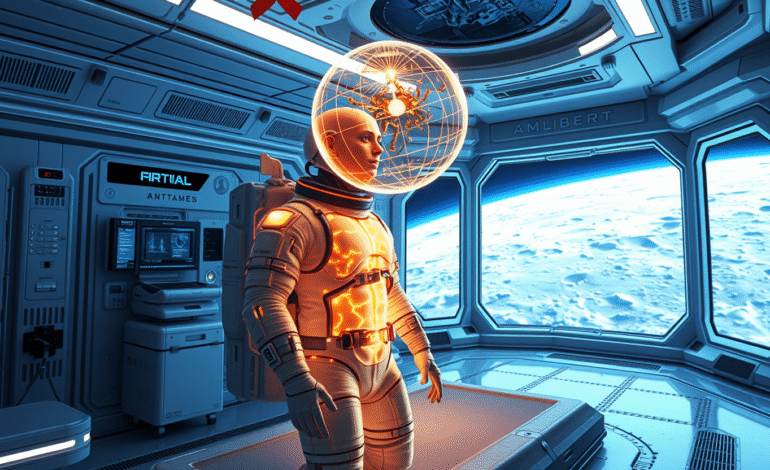
This impending shift necessitates NASA’s efforts to advance on-orbit medical care towards becoming more “Earth-independent.” One pioneering initiative is a proof-of-concept AI medical assistant developed in collaboration with Google. Known as Crew Medical Officer Digital Assistant (CMO-DA), this tool is designed to aid astronauts in diagnosing and treating symptoms when no doctor is available or communication with Earth is disrupted.
The multimodal tool, which encompasses speech, text, and images, operates within Google Cloud’s Vertex AI environment.
The project functions under a fixed-price Google Public Sector subscription agreement, covering cloud services, application development infrastructure, and model training. David Cruley, customer engineer at Google’s Public Sector business unit, reported this information. NASA retains ownership of the app’s source code and has contributed to fine-tuning the models. The Google Vertex AI platform offers access to models from Google and other third parties.
CMO-DA has undergone testing in three scenarios: ankle injury, flank pain, and ear pain. A panel of physicians, including an astronaut, assessed the assistant’s performance across initial evaluation, history-taking, clinical reasoning, and treatment.
The panel noted a high level of diagnostic accuracy, scoring the evaluation and treatment plan for flank pain at 74%, ear pain at 80%, and ankle injury at 88%.
NASA’s roadmap for this project is deliberately incremental. Scientists plan to incorporate additional data sources, such as medical devices, and train the model to be “situationally aware” — that is, attuned to space medicine-specific conditions like microgravity.
Cruley remained noncommittal regarding Google’s intentions to pursue regulatory clearance for this type of medical assistant in Earth-based medical facilities, but such a move could be a logical next step if the model is validated in space.
Beyond improving astronaut health in space, “the lessons learned from this tool could also have applicability to other areas of health,” Cruley stated.